
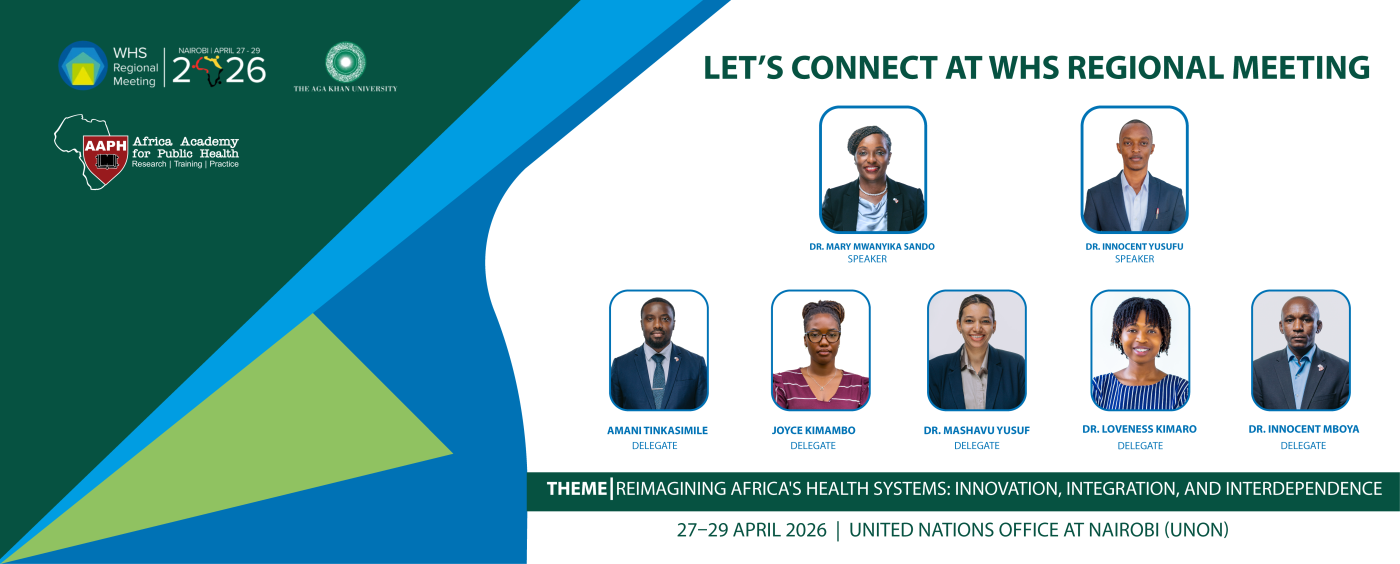
African Academy of Public Health (AAPH) contributed to the World Health Summit Regional Meeting (WHS RM) in Nairobi, Kenya alongside like-minded entities — joining a powerful convergence of national, regional and global voices committed to reshaping health systems for the challenges ahead.
To kick-off the meeting, AAPH participated in the WHS Academic Alliance convening, a global network of academic and health institutions that coordinates the World Health Summit and its regional meetings. The convening brought together the institutional representatives to chart strategic priorities, forge new partnerships, and examine the critical role that academic institutions play in driving meaningful global health action.
The 2026 WHS Regioal meeting was held under the theme Reimagining Africa's Health Systems: Innovation, Integration, and Interdependence, a renewed commitment to action. At a moment when global health financing is under strain and longstanding assumptions about aid and support are being challenged, the summit brought urgency and clarity to a set of defining questions: How does Africa build health systems that are resilient, self-sustaining, and fit for the future?
Conversations spanned the full architecture of health systems reform. On financing, delegates grappled with how to mobilize domestic resources and reduce dependency on external funding in an era of shrinking global health budgets — and with the fundamental case that health is not a cost to be managed, but an investment that governments must prioritize. Universal health coverage emerged as both an aspiration and a test — a measure of whether systems are truly client-centred. Central to that conversation was the shift from vertical, disease-specific programs toward integrated, people-centered systems where care follows the patient, not the program.
Maternal and child health commanded attention as a barometer of a system's reach and equity, reflecting how well health services meet the needs of those most vulnerable. Mental health claimed its place in the mainstream, no longer a footnote but a fundamental pillar of population health. The transformative potential of digital health and artificial intelligence was examined alongside the very real risks of leaving the most deserving behind. The growing intersection of climate change and health took center stage — a recognition that the conditions in which people live, and the planet's stability, are inseparable from health outcomes. And threading through it all was the imperative to strengthen local supply chains and manufacturing — to ensure that Africa is not merely a recipient of health solutions, but a contributing producer.
Taken together, the discussions pointed toward one conclusion: reimagining Africa's health systems is not a distant aspiration, it is the very present task at hand.
AAPH's Voice at the Summit
Across the summit's sessions, the AAPH team engaged deeply with issues at the heart of the organization's mission — maternal and child health, mental health, quality of care, and community-centered approaches to healthcare delivery. Two AAPH leaders brought forward those priorities at panel discussions.
Dr. Mary Mwanyika Sando, CEO at AAPH, spoke on a panel dedicated to Quality of Care for Women, Children, and Adolescents, drawing from the Companionship Study — a collaborative initiative between Thamini Uhai, the Ministry of Health. This demonstrated that equipping pregnant women with a companion through their care journey, and ensuring facilities were prepared to support that, meaningfully improved their experience and outcomes. The takeaway was simple but powerful: presence matters, and systems that make space for it deliver better care.
Dr. Innocent Yusufu, Research and Programs Manager at AAPH, joined a panel on mental health systems strengthening, making the case for approaches that are both deliberate and deeply contextual. He emphasized the need to build from the grassroots up — improving how mental health is understood across the continent, and investing in the kind of sustained capacity building that can transform healthcare systems from within.
Looking Ahead
AAPH leaves Nairobi not just having participated, but having contributed — and with a clear-eyed sense of what this moment demands. We believe that Africa's health future will be built on knowledge generated here, by institutions rooted here, in service of communities across this continent. At a time when the world is reconsidering how global health is funded and governed, African governments must treat health not as a line item to be trimmed, but as a strategic investment in human capital, economic productivity, and long-term resilience. African academic institutions, in turn, have both the opportunity and the responsibility to step forward — not to fill a gap, but to lead.
That is the commitment AAPH carries forward from Nairobi. The work of reimagining is already underway.